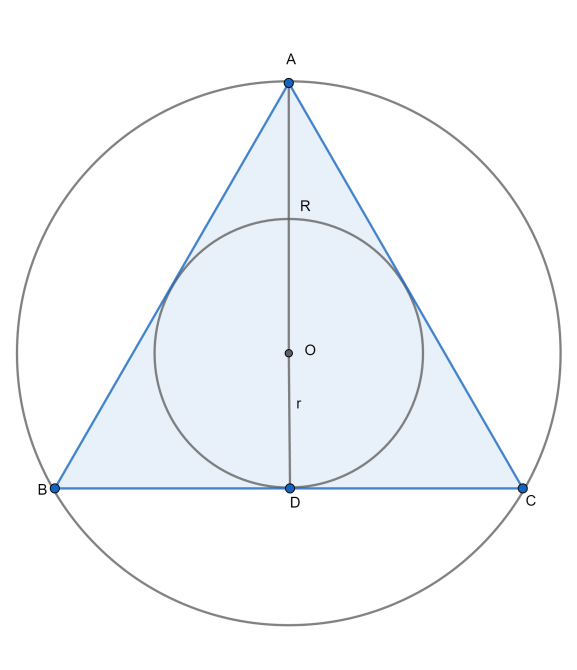
Draw a triangle and its incircle;
i.e., the largest circle we can fit inside the triangle, and
its so-called circumcircle; i.e.,
the smallest circle into which we can fit the entire triangle.
If we take:
R: radius of the circumcircle (the distance AO in the image)
r: radius of the incircle (the distance DO in the image)
d: distance between the centers of the two circles (0 in the image)
For equilateral triangles (image) the centers of the two circles are the same. Hence d = 0 and
R = 2r
You can play with this below. Make a triangle by selecting three points on the grid. The browser
then plots the incircle and circumcircle and computes R, r, d and the values from the
Euler expressions above.
!Note! The triangles you can make on the grid always consist of points (aka vertices) which 'snap'
to positions where gridlines cross; i.e., points that have whole-number coordinates.
As a consequence, you cannot create equilateral triangles since in 2D no triangle can be formed
that has only whole-number valued vertices (see proof below the grid). This may sound strange, perhaps, but no such triangle can be created on any(!)
standard digital computer screen. After all, these screens consist of pixels that are arranged in a grid
of whole-number coordinates. This implies that no matter how many pixels you have to work with,
your triangle will never be truly (mathematically) equilateral!
Little something to try: make a right triangle with sides of length 3, 4 and 5. Then look at the radius
(r) of the incircle. What does that say about the incircle's circumference and area?
Make a triangle by selecting three points on the grid.
Parameters & expressions
Values (rounded)
Triangle perimeter
Triangle area
Circumcircle radius (R)
Incircle radius (r)
R >= 2r
Distance between circle centers (d)
d2 = R(R - 2r)
An equilateral triangle cannot have whole number-valued coordinates (in 2D)
The formula for the area of an equilateral triangle is
area = (√3 / 4) * s2, where
s: length of one of the sides
If the triangle has only whole-number valued coordinates, s is a whole number and so is s2.
But since √3 is an irrational number, the area of the triangle must be an irrational number.
On the other hand, Pick's theorem says that the area of any triangle
that has only whole number-valued vertices is either a whole number or a whole number divided by 2; hence, a rational number.
The only way in which both these things can be true is when an equilateral triangle if forbidden from having
only whole number-valued vertices.